
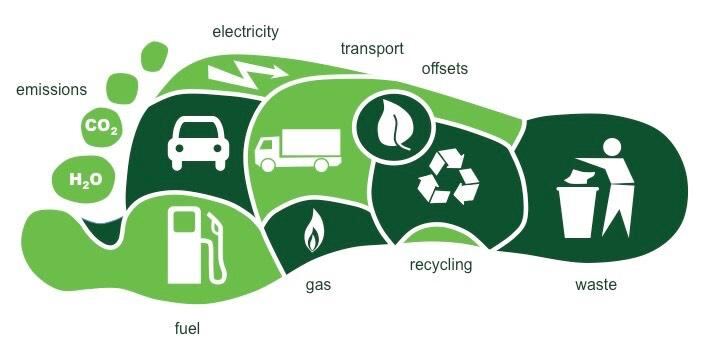
A carbon footprint is the measurement of greenhouse gas emissions, directly and indirectly released into the atmosphere by an individual, institution, or product, quantified in terms of carbon dioxide (CO₂). Every activity in our daily lives, such as transportation, energy consumption, nutrition, and consumption, shapes our carbon footprint. This measurement allows for the quantification of environmental impact and indicates areas where improvements can be made. To make individual carbon credit donations or implement a carbon offsetting program, it is first necessary to understand one's personal or corporate carbon footprint. This enables the offsetting process to be carried out consciously, targeted, and effectively.
To better illustrate this for everyone, here are some examples of carbon footprints from daily life:
Air Travel: A 1-hour flight in economy class causes approximately 250 kg of CO₂ emissions. For longer international flights, this value can increase to several tons.
Car Usage: Driving an average car for 10 km produces approximately 2.3 kg of CO₂ emissions. Daily commutes can lead to hundreds of kilograms of carbon footprint annually.
Meat Consumption: Consuming just one kilogram of red meat per week can lead to over 1 ton of CO₂ equivalent greenhouse gas emissions per year.
Electricity Consumption: The annual electricity usage of an average household translates to between 1-4 tons of CO₂ emissions, depending on the production method. This rate is even higher in regions heavily reliant on fossil fuels.
Online Shopping and Shipping: Frequent online purchases, especially if they involve air transport, can cause 500-1000 grams of CO₂ emissions per package.
These examples concretize the impact of individual behaviors on global emissions. However, the good news is that it is possible to offset these impacts by making individual carbon credit donations or participating in a carbon offsetting program.
Carbon Footprint Calculation Methods
You can easily learn about the environmental impact of your daily activities and calculate your carbon footprint using the Carbon Footprint Calculation Tool on our website. Take your first step towards a more sustainable life by using it now!
What are the Differences Between Individual and Corporate Carbon Footprints?
A carbon footprint is the total greenhouse gas emissions resulting from personal and corporate activities. However, there are some significant differences between individual and corporate carbon footprints. These differences are related to the scope of measured activities, calculation methods, and areas of impact. Here are the main differences between these two types of carbon footprints:
Scope of Calculation and Size
An individual carbon footprint covers emissions resulting from a person's lifestyle and daily activities. This includes impacts from transportation habits, energy consumption, and food choices. For example, the amount of energy an individual uses at home, the vehicles they use, and their shopping habits directly reflect on their individual carbon footprint.
A corporate carbon footprint, on the other hand, covers carbon emissions resulting from all activities of a company. This includes production processes, the supply chain, office energy consumption, and employee transportation. Corporate carbon footprints are generally calculated on a much broader scale and cover many different activity areas. Furthermore, a company's carbon footprint can be much larger than the personal footprint of many individuals.
Types of Activities and Areas of Impact
Individual carbon footprints are mostly limited to daily life activities. Personal decisions such as energy consumption, travel habits, food consumption, and waste management directly affect carbon emissions. Individual decisions directly determine a person's environmental impact.
Corporate carbon footprints, however, have a much more complex structure. A business's activities involve many factors such as supply chain management, production processes, logistics, and distribution. Additionally, a corporate carbon footprint is a process also affected by a company's suppliers and business partners. This means that the corporate footprint has a much broader and more indirect impact than the individual one.
Carbon Footprint Reduction Methods
Reducing an individual carbon footprint generally requires smaller-scale steps. This is possible by changing personal choices such as saving electricity, using public transport, choosing energy-efficient appliances, and consuming less meat. Individuals can reduce their carbon emissions by making conscious choices in daily life.
Reducing a corporate carbon footprint, on the other hand, requires more complex and long-term strategies. Companies can invest in energy-efficient technologies, create sustainable supply chains, transition to renewable energy sources, and offer eco-friendly transportation options for employees. Furthermore, companies often undertake larger-scale projects to reduce their carbon footprint, which indicates that corporate strategies require more investment and planning.
Legal and Social Responsibility
Corporate carbon footprints are generally more closely associated with legal regulations. Many countries mandate businesses to report their carbon emissions and keep them at a certain level. In this context, companies must comply with various regulatory requirements to reduce their carbon footprints.
An individual carbon footprint, however, is mostly based on voluntariness. However, with increasing social pressure and environmental awareness, individuals may also feel compelled to adopt eco-friendly habits. Nevertheless, an individual's responsibility to reduce their carbon footprint is not under as much social pressure as at the corporate level.
Measurement and Reporting
Individual carbon footprints are generally measured using personal calculation tools and are usually reported on an annual basis. This allows individuals to see how much carbon emissions they have prevented by making conscious decisions.
Corporate carbon footprints, however, require more comprehensive reporting and auditing processes. Companies generally publish sustainability reports and annual emission reports. Corporate reporting enables a company to communicate its environmental impacts to both internal and external stakeholders.