
The Congo Basin: The World's Most Valuable "Green Gold" Ecosystem and a Next-Generation Investment Opportunity
- Apr 9
- 4 min read
The Amazon Basin has been the focal point of global institutional investors and climate finance for decades. However, the Congo Basin, home to the world's second-largest tropical forest, the largest tropical peatland complex, and one of the most intense centres of biodiversity, still awaits as an undiscovered "Green Gold" reserve.
At Foundation Green Gold, our vision is to transform nature conservation from being merely a cost item into a structured investment model that secures the planet's future. The massive gap between its global ecological value and the capital currently deployed against it makes the Congo Basin one of today's most striking and transformative investment opportunities.
Why the Congo Basin and Not the Amazon?
To describe these two massive basins merely as "forests" is to overlook the fact that they are operational climate systems regulating the global atmospheric and hydrological order. However, there is a critical distinction for investors today: The trajectory.
The Amazon's Transformation: Research published in Nature and Science indicates that certain regions of the Amazon have transitioned from a net carbon sink to a net carbon source due to deforestation. Institutional integration in this area is largely complete, and the entry window is narrowing.
The Congo Basin's Integrity: Looking at the maps of tropical forests in Central Africa, it is evident that the Congo Basin remains structurally intact. The basin continues to absorb far more carbon than it emits. This structural integrity offers a time-limited, unique "first-mover" advantage for institutional investors.
The Global Value of the Congo Basin in Numbers
The fundamental ecological and structural metrics of the Congo Basin are as follows:
~3.7 Million km² Total Area: Spanning six countries, approximately 60% of the basin is located in the Democratic Republic of the Congo (DRC).
~340 Gigatonnes Carbon Stock: The estimated amount of carbon stored in biomass and peatlands.
30.6 Billion Tonnes of Peatland Carbon: The amount stored solely in the Cuvette Centrale peatlands is equivalent to roughly 3 years of total global CO₂ emissions.
<3% Share of Climate Finance: While the Amazon attracts billions of dollars in climate finance, the Congo Basin has received a minute fraction of global forest climate finance despite its superior carbon density.
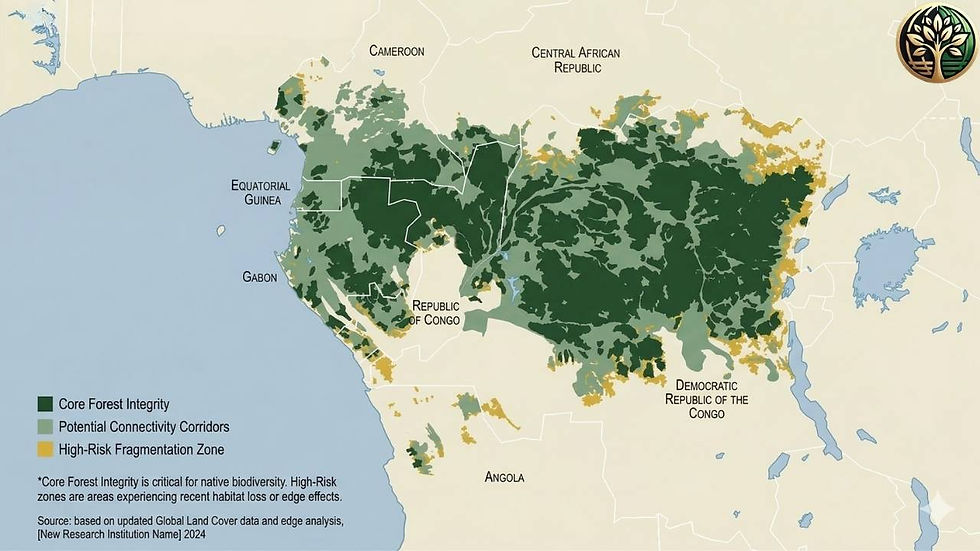
Investor Signal: This pricing asymmetry in the Congo Basin is bound to close. Tightening compliance frameworks (CORSIA, EU CBAM, Paris Agreement Article 6) and maturing voluntary carbon markets (VCM) will close this gap in favour of investors who make an early and structured entry.
From Systemic Value to "Investable" Assets
Investments in the Congo Basin have historically been shaped around extractive industries (copper, cobalt, coltan). Today, however, new and sustainable asset classes operating at the ecosystem level are coming into play:
Voluntary Carbon Markets (VCM) and REDD+: Intact forests generate verifiable carbon credits. Properly certified, high-integrity supply trades at premium pricing for corporate net-zero demands.
Biodiversity Credits: Under the Kunming-Montreal 30x30 target, biodiversity credits are a rapidly rising instrument. The Congo is positioned as a tier-1 supply region due to its endemic species density.
Blended Finance: Mineral corridor infrastructure projects can be structured with conservation co-benefits, bringing together commercial and development finance capital at the same table.
Institutional Readiness and Foundation Green Gold's 1.3 Million-Hectare Impact
The primary barrier to capital flowing into the Congo Basin is not a lack of opportunity, but a lack of institutional readiness. Institutional investors and companies with net-zero targets require transparent processes, independently verified (MRV) projects, and credible governance frameworks.
To bridge this structural gap and translate the Congo Basin's value into a bankable reality, Foundation Green Gold provides directly measurable infrastructure on the ground:
1.3 Million Hectares of Conservation Area: The Foundation has secured 1.3 million hectares of vast forest land in the Nord-Ubangi region, one of the most critical ecosystems globally for biodiversity in the Congo. This is not merely a theoretical initiative, but an active operation executed directly on the ground, aiming to prevent annual deforestation by up to 30%.
Verra Certification and International Standards: To entirely eliminate the risk of "greenwashing", the carbon storage capacity in this massive area is analysed using satellite imagery and biomass measurements in accordance with IPCC standards. The project is integrated into the certification processes of Verra (VCS), one of the most prestigious verification standards in carbon markets.
A Secure Entry Point for Institutional Investors: Foundation Green Gold is not just an environmental initiative; it is positioned as a transparent, auditable, and de-risked entry point into the Congo Basin for international institutions, funds, and companies making net-zero commitments. Through this, investors gain direct and secure access to high-impact forest carbon credits.
Time to Act
The Congo Basin is no longer just a "nature conservation project"; it is a rational, multi-layered, and high-yield asset class. The 2025–2030 period is a critical window for setting standards and capitalising on the premium of being a first-mover in the market.
Foundation Green Gold's 1.3 million-hectare initiative under Verra standards has already built that solid bridge expected by institutional capital. Channelling capital into this basin is no longer a question mark; it is a matter of realising this initiative as soon as possible through accurate data and structured partners like Foundation Green Gold. The economy of the future will belong to those who transparently reflect the value of nature on their balance sheets.


Comments