
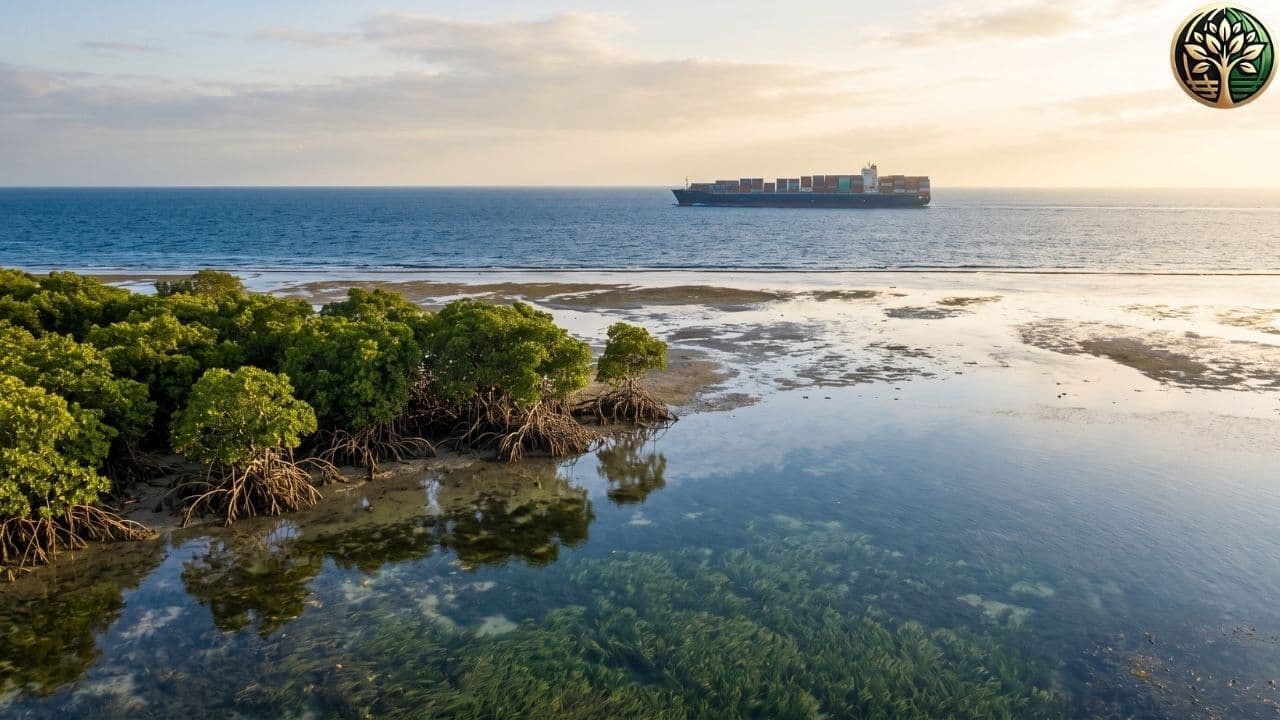
Approximately 80% of global trade is transported by sea. As the backbone of the international economy, the maritime shipping industry is also responsible for nearly 3% of global anthropogenic greenhouse gas emissions. With the accelerating climate crisis, decarbonizing maritime transport has risen to the top of global sustainability mandates.
The International Maritime Organization (IMO)'s 2050 Net-Zero targets are pushing shipowners, freight forwarders, and port operators to rapidly reduce their carbon intensity. While alternative marine fuels (ammonia, methanol, hydrogen) remain in scaling phases, maritime's most immediate and effective ally on the net-zero horizon lies in nature's most potent carbon sinks: Blue Carbon Ecosystems. The Green Gold Foundation’s Green Gold Sea initiative delivers a robust, science-based, and high-integrity offsetting framework tailored specifically for the maritime sector.
IMO 2050 Targets and Decarbonization Pressures in Shipping
Regulatory pressures on the maritime domain have intensified significantly. Under the IMO’s revised Greenhouse Gas Strategy:
- 2030 Interim Checkpoint: Target to reduce total annual GHG emissions from international shipping by at least 20-30% compared to 2008 levels, while ensuring zero or near-zero GHG technologies represent at least 5-10% of energy used.
- 2040 Interim Checkpoint: Target to reduce total annual GHG emissions by at least 70-80% compared to 2008 levels.
- 2050 Ultimate Goal: Mandated realization of net-zero GHG emissions across international shipping.
To enforce these targets, mandatory frameworks such as the Carbon Intensity Indicator (CII) and the Energy Efficiency Existing Ship Index (EEXI) are active. However, technical vessel retrofits and fuel efficiency measures alone cannot fully bridge the gap to net-zero in the short to medium term.
What is Blue Carbon? The Unmatched Sequestration Power of Coastal Ecosystems
Blue Carbon refers to carbon dioxide captured from the atmosphere and oceans, then stored within coastal and marine ecosystems—primarily mangrove forests, seagrass meadows, and tidal salt marshes.
Unlike terrestrial forests that store the majority of their carbon in above-ground biomass (trunks and leaves), blue carbon ecosystems sequester carbon predominantly within anaerobic (oxygen-depleted) coastal soils. This environment prevents rapid decomposition, locking carbon away for centuries or even millennia.
Mangrove Forests
Adapted to saline coastal waters and tidal surges, mangroves can sequester up to 3 to 5 times more carbon per hectare than tropical terrestrial rainforests. Furthermore, they mitigate coastal erosion, act as natural storm buffers, and serve as vital marine nurseries.
Seagrass Meadows
Despite covering less than 0.1% of the ocean floor, seagrasses account for roughly 11% of the total organic carbon buried in ocean sediments annually. They active capture atmospheric carbon, reduce localized ocean acidification, and support coastal biodiversity.
Green Gold Sea: A Tailored Nature-Based Solution for Maritime
Building upon its successful management of the 1-million-hectare Nord-Ubangi REDD+ project in the Congo Basin, the Green Gold Foundation extends its high-integrity conservation methodology to coastal waters through Green Gold Sea.
Green Gold Sea is engineered to safeguard threatened mangrove ecosystems, restore degraded seagrass beds, and foster sustainable livelihoods for coastal communities.
Green Gold Sea Core Pillars:
- High-Density Carbon Sequestration: Generates Verified Blue Carbon Credits to neutralize residual maritime emissions.
- Coastal Resilience: Fortifies shorelines against sea-level rise and extreme storm events.
- Marine Biodiversity: Restores critical habitats for endangered marine species and fish stocks.
- Socio-Economic Co-Benefits: Empowers local coastal communities through eco-tourism, sustainable aquaculture, and conservation jobs.
Step-by-Step Blue Carbon Offsetting Framework for Shipping Companies
A structured 5-step roadmap for shipping companies to integrate Green Gold Sea into their net-zero strategy:
- Voyage and Fleet Emission Auditing: Collect and quantify total fleet $CO_2e$ emissions utilizing data from IMO DCS (Data Collection System) and EU MRV frameworks.
- Operational Efficiency Optimization: Execute immediate reduction measures, including speed optimization (slow steaming), hull maintenance, and route planning.
- Scope 1 & Scope 3 Residual Footprint Calculation: Identify unmitigated residual emissions that cannot yet be eliminated through operational or fuel changes.
- Green Gold Sea Offsetting: Retire certified Blue Carbon credits generated by Green Gold Sea projects, backed by rigorous MRV and international carbon standards (VCS / CCB).
- ESG Disclosure and Regulatory Reporting: Integrate verified carbon neutrality certificates into corporate ESG reporting, EU ETS compliance documentations, and stakeholder disclosures.
Executive Summary & Key Highlights
- Topic: Blue Carbon Ecosystems (Mangroves, Seagrasses), IMO 2050 Net-Zero Goals, and the Green Gold Sea Initiative.
- Core Challenge: Maritime shipping carries 80% of global trade and generates ~3% of GHG emissions, face strict regulation alongside delayed availability of alternative fuels.
- Solution: Combining fleet operational efficiency with high-capacity Blue Carbon offsetting to tackle hard-to-abate residual emissions.
- Green Gold Solution: Green Gold Sea project delivering certified blue carbon credits, coastal wetland restoration, and verifiable corporate carbon neutrality.
- Target Audience: Shipowners, maritime logistics companies, port operators, marine ESG directors, and sustainability managers.
Frequently Asked Questions (FAQ)
How do Blue Carbon credits differ from terrestrial forestry credits?
Blue Carbon ecosystems store carbon up to 4 to 10 times faster per hectare than terrestrial forests and lock it away in subaquatic sediment for centuries. Because sediment carbon is submerged and oxygen-deprived, it faces significantly lower risk of re-release from forest fires compared to terrestrial timber.
Is carbon offsetting recognized under the IMO 2050 framework?
While the IMO prioritizes direct emissions reduction and zero-emission fuels, high-integrity carbon offsetting via Blue Carbon is an internationally recognized mechanism for managing residual emissions, achieving corporate carbon neutrality, and satisfying ESG rating requirements during the transition phase.
How is the scientific integrity of Green Gold Sea verified?
All Green Gold Sea project areas undergo continuous Measurement, Reporting, and Verification (MRV) using satellite imagery, field sampling, and independent auditing. Credits are verified under leading international standards such as Verra (VCS) and the Climate, Community & Biodiversity (CCB) Standards.
How does Green Gold Sea align with regulations like the EU ETS for maritime?
As the EU Emissions Trading System expands to cover shipping emissions, operational compliance costs rise. Participating in Green Gold Sea empowers maritime operators to meet voluntary net-zero commitments, strengthen ESG profiles, and build resilience against evolving international carbon pricing frameworks.