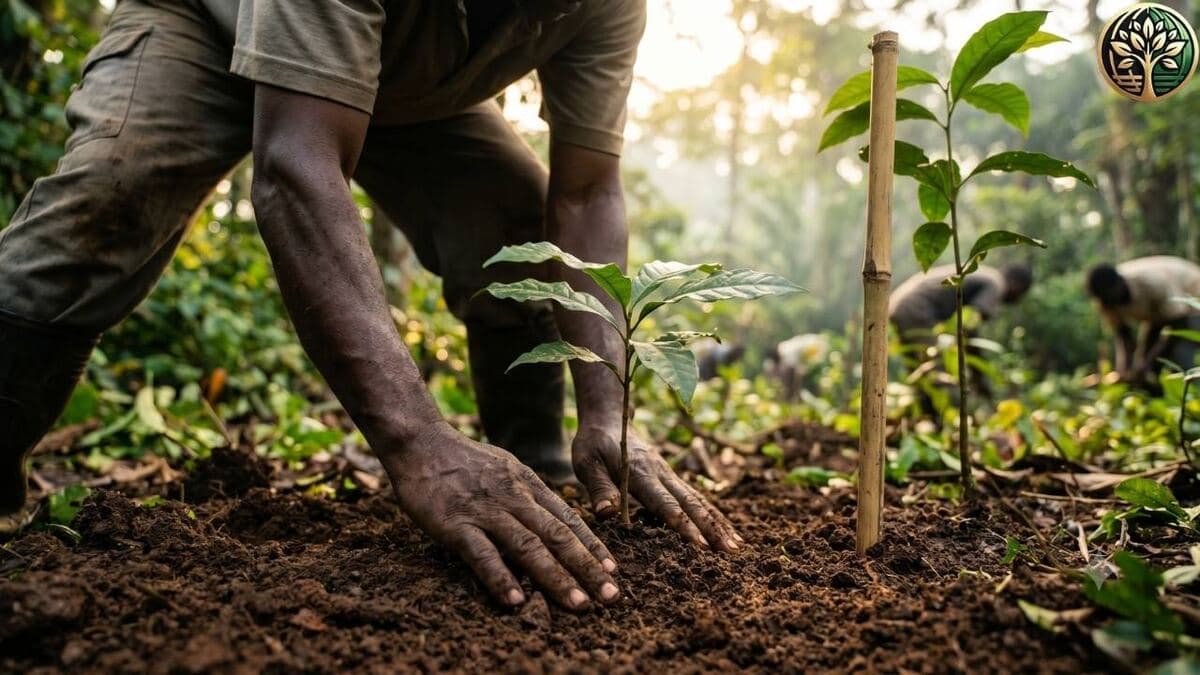
Photosynthesis, nature's most flawless technology, has been maintaining our planet's carbon balance for billions of years. As trees grow, they absorb carbon dioxide ($\text{CO}_2$) from the atmosphere through their leaves, store the carbon in their trunks, branches, and roots, and release oxygen back into the sky. But how does this silent miracle of nature transform into a verified, commercial asset—a carbon credit—that serves the climate goals of global corporations in today's green economy?
Reforestation (ARR) and forest conservation projects sit at the very heart of corporate sustainability strategies. However, turning a sapling planted in the soil into an internationally recognized "carbon credit certificate" requires strict scientific formulas and transparent auditing processes. At the Green Gold Foundation, we outline the fascinating transformation process from planting a tree to issuing a carbon credit in full technical and transparent detail.
From Photosynthesis to Finance: How Carbon Sequestration Works
For a reforestation project to generate carbon credits, it must first and foremost produce "measurable biomass". The process fundamentally moves through the following stages:
1. Biomass Accumulation (Tree Growth)
As a planted sapling grows, it accumulates woody tissue. Approximately 50% of a tree's dry weight is composed directly of carbon. The growth rate, density, and root structures of the tree species within the project area are the primary mathematical variables determining how much carbon that forest sequesters annually.
2. Tonne of $\text{CO}_2$ Equivalent ($\text{tCO}_2\text{e}$) Calculation
The fundamental unit in carbon markets is 1 tonne of $\text{CO}_2$ equivalent. The pure carbon stored within the tree's biomass is converted into the amount of $\text{CO}_2$ removed from the atmosphere using chemical conversion factors—specifically by multiplying the molecular weight ratio of carbon to carbon dioxide, which is $3.67$. Therefore, a project's success is measured by how many tonnes of $\text{CO}_2$ gas are permanently erased from the atmosphere.
The 4 Critical Stages Turning a Sapling into a Credit
Planting random trees in a forest area does not automatically create carbon credits. To generate credits accepted by international standards (such as Verra or Gold Standard), the following methodological processes must be fully completed:
Criterion 1: Baseline Scenario and Additionality
Before the project begins, the area is meticulously mapped to answer the question: "What would happen to this land if this project did not take place?" If the land would reforest on its own or if the project could be executed without carbon finance, it cannot generate credits. The project must prove additionality—meaning it must be demonstrated that those trees would never have been planted without the financial backing of carbon credits.
Criterion 2: MRV (Measurement, Reporting, and Verification) Technologies
Once the trees are planted, the forest is never left to fate. Radical transparency is essential in modern carbon projects:
- Satellites and AI: Satellite imagery and LiDAR technologies continuously monitor the density of the canopy from above.
- Field Sampling: Forestry engineers physically venture into the field to measure tree heights and diameter at breast height (DBH), verifying precise growth rates.
Criterion 3: Leakage Management
If reforesting one area causes local communities to shift their agricultural or livestock activities to another area and cut down a different forest, this is known as "leakage". A high-quality project must eliminate leakage by providing alternative, sustainable livelihood models for the local population.
Criterion 4: Independent Third-Party Verification
All collected MRV data and carbon calculation reports are audited on-site by internationally accredited Validation and Verification Bodies (VVBs). The calculated amount of carbon per tonne that successfully passes the audit is registered and issued with a unique serial number as a carbon credit in official registries.
Green Gold Foundation: Every Sapling a Global Shield in Nord-Ubangi
At the Green Gold Foundation, we seamlessly integrate forest conservation (REDD+) with reforestation and agroforestry models within our massive 1-million-hectare ecosystem project in the Nord-Ubangi region of the Democratic Republic of the Congo.
By providing agroforestry training—growing agricultural crops alongside trees—to the local population, we restore degraded lands whilst lifting the economic pressure off the existing primary rainforests. As a result:
- We prevent millions of tonnes of $\text{CO}_2$ emissions by reducing annual forest loss by 30%.
- Through our Green Gold Wings, Wheels, and Stay sectoral programmes, we produce the highest quality, verified nature-based solutions (NbS) for companies to offset their corporate carbon footprints.
Executive Summary
- Carbon Credit Fundamentals: Carbon credits are generated based on the amount of carbon trees sequester through photosynthesis as they grow, calculated in units of 1 tonne of $\text{CO}_2$ equivalent ($\text{tCO}_2\text{e}$).
- Methodological Process: For a reforestation project to issue credits, it must prove additionality, prevent leakage risks, and undergo rigid MRV (Measurement, Reporting, and Monitoring) protocols.
- Verification and Certification: Forest growth data collected via satellite tech and field measurements are verified by independent international auditors before being certified as tradeable carbon credits.
- The Green Gold Foundation Model: Operating across 1 million hectares in Nord-Ubangi, the Foundation deploys agroforestry and conservation to reduce annual deforestation by 30%, generating transparent, verified premium credits for corporate ESG targets.
Frequently Asked Questions (FAQ)
1. Does a newly planted sapling generate carbon credits immediately?
No. In reforestation projects, credits are generally issued on an ex-post basis. This means the credits are only issued after the tree has actually grown and physically sequestered the carbon, which is measured via MRV processes and verified by independent auditors. Consequently, the growth of the saplings must be monitored regularly over time.
2. What happens to the carbon credits if the planted trees dry up or are destroyed in a fire?
This risk is known as the "permanence" risk. International standards resolve this by utilising a "Buffer Pool" mechanism. A specific percentage (typically 10% to 20%) of the issued credits is never sold and is instead held in a collective insurance pool. If a natural disaster occurs within the project, the lost carbon is deducted from this buffer pool, thereby maintaining the environmental integrity of the system.
3. How does agroforestry increase the quality of a carbon credit?
Instead of planting a monoculture forest, combining agricultural crops that provide food for local communities with forest trees that support the ecosystem (agroforestry) maximises the project's social and biodiversity co-benefits. Because local people secure their livelihoods from these managed lands, they stop clearing the native forest. This increases the permanence and quality of the credit, elevating it to a "premium credit" status.
4. How can our company get involved in this credit production and donation cycle?
Your company can integrate with the Green Gold Foundation’s Wings (Aviation), Wheels (Logistics), or Stay (Hospitality) programmes depending on your sector. Once your operational emissions are calculated, your corporate donations directly finance the MRV processes of our reforestation and conservation activities across 1 million hectares in Nord-Ubangi, providing you with international-standard sustainability certificates for your ESG reporting.